
Los Angeles
March 2026
Written by
Faith Olaleye
A Response to Karsten Kroening
THE CASE FOR GRAFFITI
Sneakers swiftly scale the column of a billboard, paint hissing as it streaks across an advertisement under the cover of night.
When traditional mediums fail to address their shortcomings regarding accessibility, race, and class, graffiti answers the call. Descending from a centuries-old history of wall markings, modern graffiti has been able to permeate the culture, expanding beyond billboards into galleries, clothing, music, and film. Yet, despite its many achievements and capabilities, this art form is not awarded the same respect as its counterparts.
The Accessible Medium
Modern graffiti was born from humble beginnings in the 1970s. In the Northeast, young people from marginalized communities began marking their names in public places, using spray paint and other materials. The most notable of these is the father of modern graffiti, Darryl “Cornbread” McCray, a black man credited with pioneering tagging.
In 1965, McCray served time in a juvenile corrections facility, where he gained his nickname and discovered the art style he would grow to popularize. Gang members would write their names on the walls, and though he was never part of a gang, McCray began to do the same, becoming the first person to tag using their name and not an affiliated symbol. After he was released from juvie, he formed a crush on a girl in his class, and, desperate to gain her affection, began tagging “Cornbread Loves Cynthia” all around North Philly. After winning her over, he’d continue spreading his work around the city, on buses and buildings.
Graffiti spread to other cities, like New York, where young people began expressing themselves through tagging, without being gang-affiliated. In New York, it found new forms of transportation. Artists would often cover trains and subway cars with graffiti, allowing their work to travel the city and gain them exposure.
In the 70s and 80s, many cities would push to criminalize tagging, leading to the arrest and prosecution of many artists. Nevertheless, the art form broke into the mainstream as individuals like Jean-Michel Basquiat, who brought elements of the style and culture into their work, paving the way for a broader acceptance of graffiti in the art world.
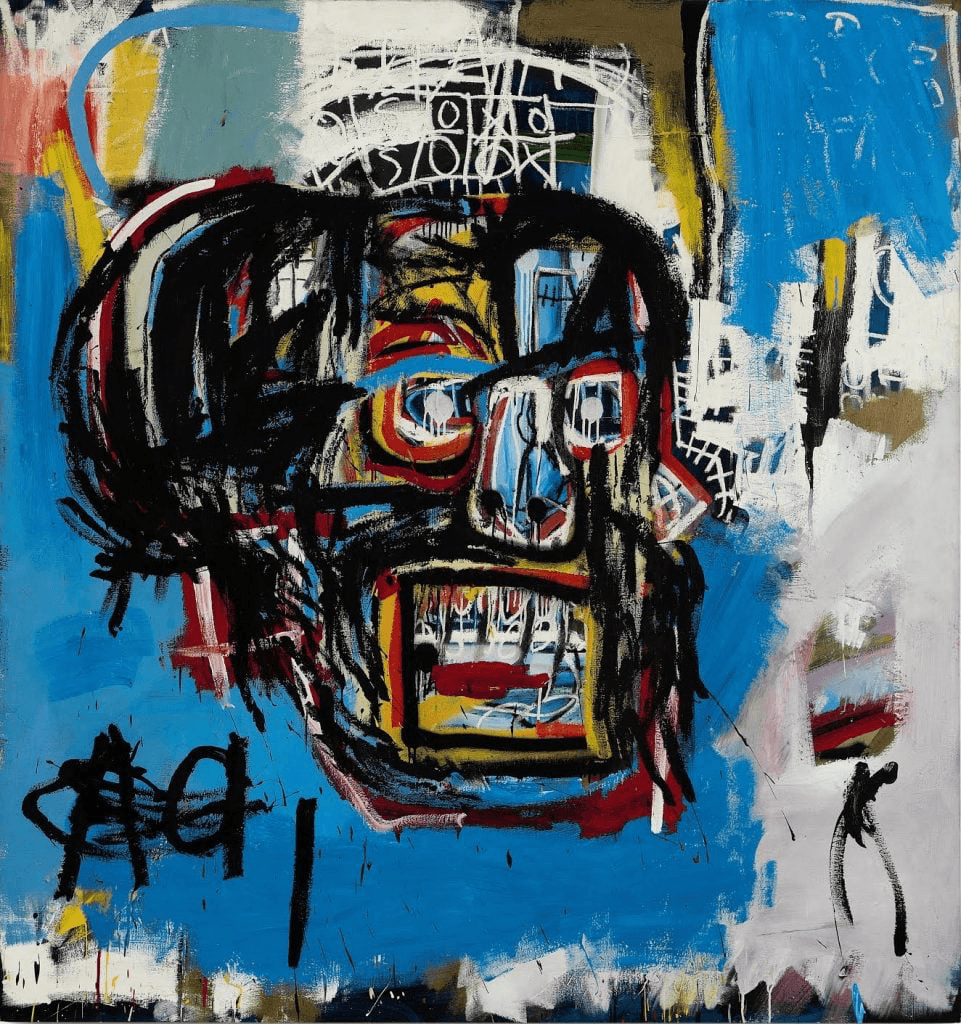
Jean-Michel Basquiat, Untitled (1982)
Jean-Michel Basquiat hailed from Brooklyn and found success as a part of the neo-expressionism movement, a period characterized by figurative drawings with vivid colors and rough brushstrokes. He first gained acclaim in the 70s as part of the graffiti duo SAMO, who displayed their work around the city, most notably in the Lower East Side, which was the epicenter of punk, hip hop, disco, and street art at the time.
Basquiat’s work focused on social issues, shedding light on his experience as a Black man in America, and calling out systemic inequalities. He incorporated tags and symbols in his work, rooted in his past as a graffiti artist, which visually had a childlike appearance, bold colors, and utilized mixed media, such as spray paint, oil sticks, and found objects.
One of his most famous pieces, Untitled (1982), features a skull, accented by thick black lines, reds, yellows, blues, and spray-painted white throughout. It’s now one of the most expensive paintings ever acquired, as it sold for $110.5 million at Sotheby’s in 2017. Despite Basquiat’s untimely death at the age of 27 in 1988, his legacy has carried on in the art world and beyond. His distinct style cemented the fact that art forms created by the people deserve a place in the art canon and are capable of graduating into the modern art world.
Graffiti’s Graduation
Today, graffiti can be found in many of the same places it started, street corners, subway cars, and bathroom stalls, but it’s also earned a place in music, film, fashion, and museums.
One of the most notable graffiti artists of our time, KAWS, has been able to blur the lines between commercial and fine art.
Born Brian Donnelly, he found his way to graffiti in high school, when he painted his alias on the roof of a building so that he could see it from his seat in class. He went on to attend the School of Visual Arts in New York City and briefly worked as a freelance animator on projects like 101 Dalmations, before taking up graffiti in the 90s. During the day, he’d work as an animator, and at night he’d spread his work around the city, subvertising, making spoof advertisements on billboards, phone booths, and bus shelters.
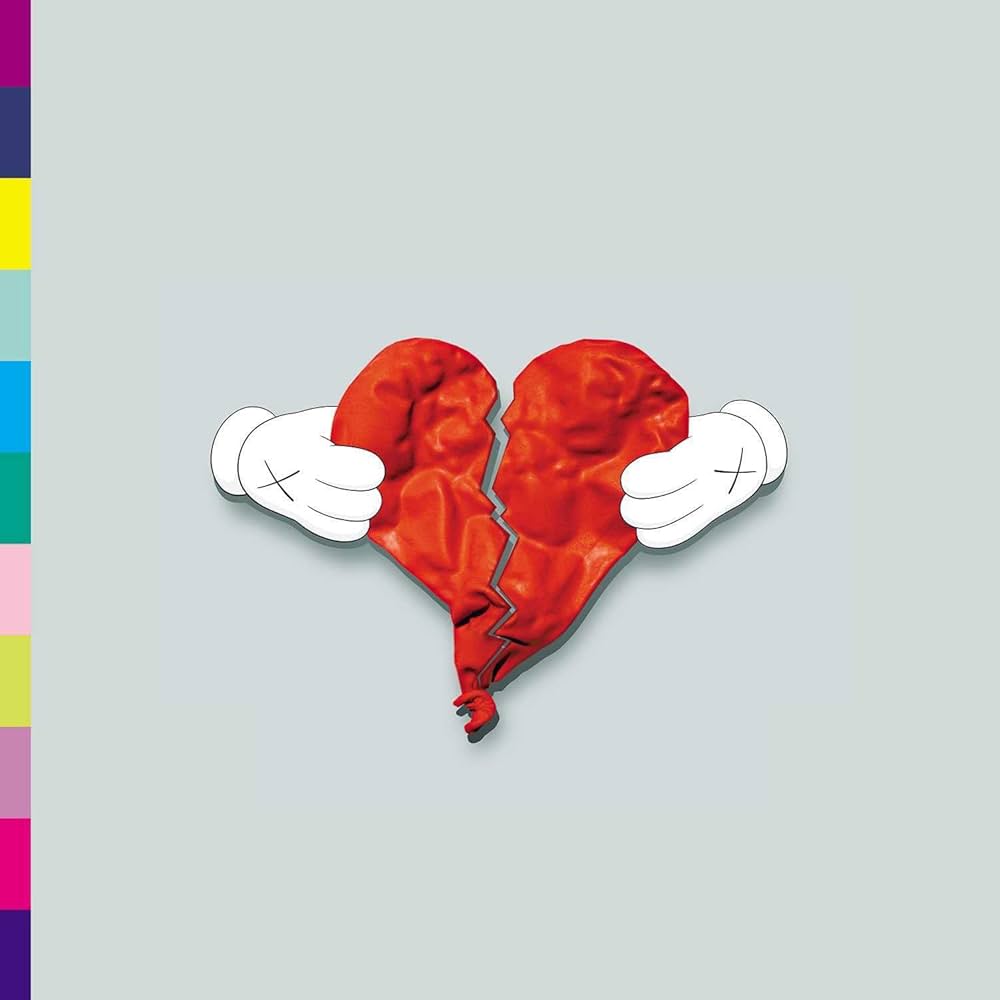
Kanye West, 808s & Heartbreaks (2008)
KAWS's style is easily recognizable, as he often subverts popular cartoon characters, like Mickey Mouse, with x’s on their eyes or hands, positioned in a shy pose with their hands over their noses. In his work, KAWS emphasizes color and line. His characters have been mass-produced as collectible figurines worth thousands, as sculptures spanning over 150 ft, featured in paintings, and displayed on clothing items through collaborations with Nike and Uniqlo. Famously, his work was featured on the cover art of Kanye West’s 2008 album, 808s & Heartbreak, illustrating the connection between graffiti and hip hop culture, while also representing how the art form has expanded into different segments of society.
Graffiti & Hip Hop
Graffiti and hip hop have been intertwined since their inception. Hip-hop is an umbrella of multiple art forms, and has five pillars: rap, djing, breakdancing, knowledge, and graffiti. While Cornbread brought graffiti to Philly, TAKI 183, a Greek-American artist from the Bronx, is credited with beginning the use of graffiti in hip-hop. It’s alleged that TAKI learned graffiti from another artist, JULIO 204, who worked with Cornbread in Philadelphia before moving up to New York. TAKI was incredibly fast at putting up work, and at just 17 years old, he’d tag public buildings around New York, including those on Broadway and in JFK Airport. Eager to compete with him, a new generation of artists merged graffiti with hip-hop. As hip-hop gained mainstream appeal, its look was emulated, and graffiti spread as a result.
Graffiti in Fashion
In fashion, graffiti’s connection to hip-hop culture has allowed it to influence the taste and artistic choices of many designers we see today. Designers like Virgil Abloh used graffiti stylistically with their clothing brands. Abloh’s first step into the fashion world was through his brand Pyrex, which gained notoriety for its simple screenprinted designs and the use of tagging in promotional videos.
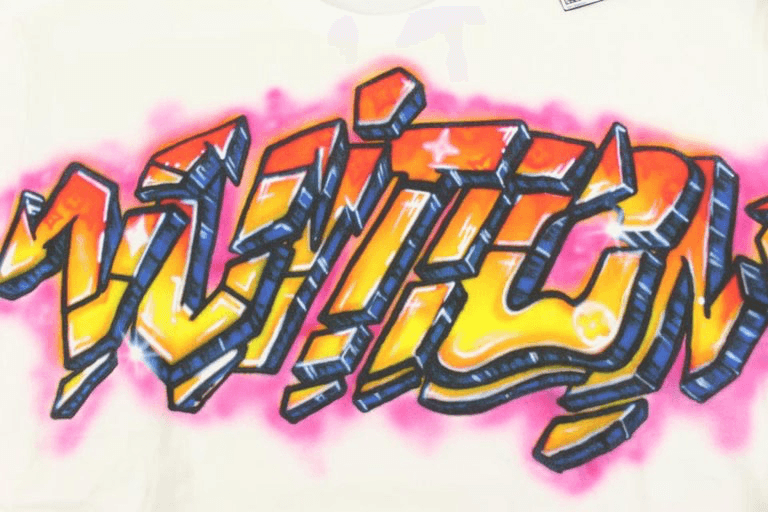
Louis Vuitton Men’s XL Tee Shirt - Virgil Abloh
Virgil Abloh, who sadly passed at 41 in 2021, had a deep connection to skating, djing, and hip-hop. Albloh used graffiti in his work with Louis Vuitton on an Air Force 1 collaboration and in runway pieces, as well as in his personal brand Off-White, displaying it on high fashion and streetwear pieces. As a designer, he built a legacy that ties together cultural movements, like hip-hop, djing, and graffiti. His work echoes the importance of integrating other non-traditional forms of expression into the modern art world.
Where Tradition Falls Short
Graffiti exists at an intersection between publicly accessible spaces and more traditional settings. Street artistry grew in popularity when people of color began using it as a means of artistic expression. Rather than being locked away in a museum out of reach from the common man, graffiti decorates life, on your commute to work, in public bathroom stalls, and influences the designs of your favorite t-shirt. Graffiti laughs in the face of class barriers, its ever-growing legacy transcending them in ways traditional mediums have failed to, impacting communities across continents and cultures, and expressing the unspoken.
Mediums like painting, which are typically deemed more traditional or “artistic”, were historically reserved for the upper class. One needed access to money for materials, training, and entry into the field. This structure made it so that art was only deemed worthy of being made or viewed by those who could afford it.
Graffiti, on the other hand, was started by youth as a means of artistic expression across cultures. Unlike traditional media, it exists in a public arena, painting our daily lives. Graffiti doesn’t require immense financial ability to participate in and has no barrier to entry.
What graffiti offers people, regardless of class, race, or demographic, is that it gives a message that’s raw and directly indicative of the culture. It’s not hindered in the way other mediums are; it’s audacious and in your face. Street art is not simply reserved for a specific age, though it started among the youth. It’s now an iconic form that anyone of any age and any culture around the world can use as a form of expression and make the viewer feel something.
Graffiti addresses many of the hurdles that traditional art has failed to overcome and continues to construct. Moreover, it supercedes these barriers of class and race. Graffiti stretches beyond the confines of traditional mediums. It can serve as propaganda or a way to immortalize people, like the Kobe and Nipsey hustle murals all around Los Angeles.
Graffiti is a radical form of communication popularized by one person's expression of love, which now exists as a form of art that the entire world can partake in. Even at the risk of freedom, people have been persistent in using it. That's a powerful medium. One capable of connecting culture across art, fashion, music, and film, and one deserving of the same respect as its more traditional counterparts.
© Forward 2026
"For the Future"